Showing posts with label How to. Show all posts

Sunday, September 23, 2012

LB How 2s: LTCs

Ok, hold on tight! This is going to be a long one with TONS of pictures to help!

In this How 2s I am going to explain how to join an LTC tracker and begin your journey on making some LTCs. For now this is going to be the basics. There are many advanced things that I have yet to do when it comes to creating these cards.

To start off, what is an LTC?
"Short for Letterboxer Trading Cards, an offshoot of Artist Trading Cards (ATC), which itself is an offshoot of traditional trading cards such as baseball cards. Letterboxer Trading Cards must be 2.5"x3.5", or 64x89mm, with a base that has the thickness and consistency of card stock, and typically incorporate your signature stamp in some way" (AtlasQuest Letterboxing Glossary).

Signing Up

Before you start making any cards we first need to join a swap you would like to do.
Go to "My Page" and click on "Trackers."
 
 Next, look at the "Available" row and choose LTCs.
A huge list should then appear of what LTC swaps are available.
Click on a listed tracker that you may be interested in.
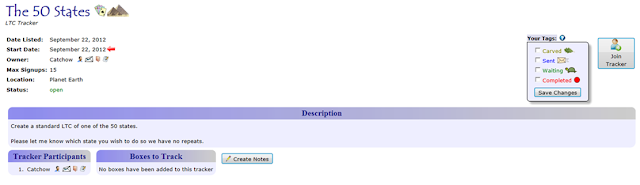
 

We are going to "join" this tracker for this tutorial. This is how the tracker will look before you join.
 
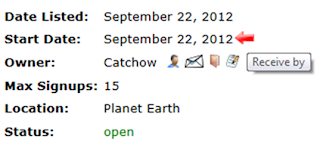
This tracker is currently open so you can join. You will also see that it has a max sign up of 15 people. Before you join you need to consider if you will make the deadline. In this case, the red arrow pointing to September 22, 2012 means that the host needs to have your cards by that date.
If it has a green arrow after the start date, that means you HAVE to send your cards on that date at the latest.
Now, join the tracker!!
 
 Now that you have joined, the screen should look like this. The host usually puts their address in the "Post" section that appears after you join. The host will have all the info you need for the swap listed in the description.

For this tracker, the deck of cards indicates that it is an LTC swap. The pyramids, indicate that it is a themed swap. For this tracker, the theme is "States."
 
 
Making LTCs
Now that you have signed up for this LTCs swap, it is time to make the cards themselves.
An LTC must be 2.5"x3.5", or 64x89mm. It also needs to be made of card stock or something with the consistency of card stock. I use not only regular card stock, but also card stock-like scrapbooking paper.
I recommend, if you have one, using a paper cutter and not just scissors to cut out your cards. It gives them a nice straight, smooth look to them.
This link shows the best way to get the most cards out of one sheet of different sized paper:
 Next, you need to Hand Carve (Coming Soon) a stamp. For an LTC it is required that the stamp is hand carved. Once the stamp is carved, stamp it onto the cards that you cut out earlier.
Now that all your cards are stamped, you need to label the back of the cards.


The top of the card needs to have the name of the LTC you have made. At the bottom right corner you will put the number out of ___   i.e. 1/15, 2/15, 3/15, 4/15, ect.
You have a choise of making the card single, limited, unlimited, or not specified. Most cards are limited and will have the 1/# on the bottom right corner. If you are making an unlimited card you will just place one number in the corner like in the picture above.
 
After all the cards are done the proper thing to do is put them in trading card sleeves.
Not everyone who is hosting an LTC swap will require that you have sleeves. Most people put the LTCs in trading card Binder Sheets so the cards don't end up staying in the sleeves. Having the cards in sleeves are useful when doing single trades or trading at letterboxing events. Yes, you can trade your cards outside the swap you joined. If you join a swap that has a max of 15 people you can make more than that to trade with people outside the swap. Keep in mind, these are trading cards.
 
 
When all is done and you are ready to send your LTCs out to the swap host, you need to make a Self-Addressed Envelope. Now after you have created your self-addressed envelope don't just dump all your cards into the envelope. To minimise cost of sending your LTCs here is how you should put them Inside the Envelope.
When you send the cards for the swap send all that are needed. If 15 people are in the swap, send 15 cards. Yes, you will be getting back of your own cards because it is part of the set in the swap you joined. It also makes it much easier on the host to sort out cards.

After you send the cards to the host it may be awhile before you get your new cards. The host needs to receive all the cards and then make sure everyone gets one of each card.
And don't forget to include enough stamps for the host to send the LTCs back to you!
 
Hope this helped any one new to LTCs!
 
Check out some LTCs here:
 
Also, you can check out more on LTCs on atlasquest regarding some more advanced thing you can do with LTCs and other things. You can also join the LTC board on atlasquest to ask questions and see what's new in the LTC world.
 
If you have any questions feel free to ask me and I'll try my best to answer them!
 
 
~Catchow


Saturday, September 15, 2012

LB How 2s: Micro Boxes

What is a micro box?

"Micro boxes, as the name implies, are very small letterboxes. These boxes open up the possibility of more clever and devious hiding places, and make it easier to prevent accidental discovery. They can be almost impossible to find without precise solving of the clues, and, despite their size, can be constructed to offer a surprisingly large stamp and logbook" (The Letterboxer's Companion by Randy Hall [1st edition] 71).

Micro boxes are neat boxes to find. When they are posted online they are listed as traditional letterboxes. When you go out searching for a box you don't know the size and some times they are micro boxes. You'll find them in small holes in trees, hidden in stone walls, and any where else you can fit a small box into.
A lot of times these boxes are are made from 35mm film canisters or small medicine bottles. Some may or may not have a log book depending on the size and the planter. Most times the log book will be rolled up into the canister. The stamps you might find in theses boxes are usually quiet small but you can find some pretty large stamps in them too.
Not all micro boxes are some sort of canister. One of my micro boxes is a Small glass bottle. The logbook is very small and rolled up into the bottle. You have to stick one finger in the bottle to pull the log book out. Now the stamp. It's smaller than a dime and is on the bottom of the cork that closes the bottle. Now since it's a glass bottle, I didn't want to send it out into the wilderness risking it breaking or getting very wet. Even though the glass was quiet thick I places it indoors.

You never know when you'll find a micro box. They often show how talented the carver might based on how well the stamp is carved. They are fun the find and often amazes you where these little things are hidden!

~Catchow

Sunday, August 19, 2012

LB How 2s: Finding Boxes

Once you have your gear and your clues now you need to go out and find the boxes!
Remember when you head out, the box may or may not be there. Always check when last the box was found before heading out. If you want to be the boxer who goes out and confirms the missing box go right ahead! You might be a hero saving the box and showing it’s still there.
Any who, try to find out about the area you are going to be hiking through. You will want to know if the area may be unsafe during the day and/or night, if there might be dangerous animals like bears, and when closing and opening times are.
Where ever you are hiking around looking for letterboxes remember to be stealthy. There are noxers (non boxers) out there and you don’t want them to know what you are doing. Also be respectful. A lot of boxes are hidden at historic location, cemeteries, and parks so you want to be respectful while out on these ground. Abide by the park rules. Don’t pick flowers or disturb the forest and don’t feed the bears! But there will be one rule you will always break, going off the trail. Can’t really get around that and you’ll be busted for picking flowers and less likely busted for going off trail. Also, if you bring your dog please pick up after him/her. No one wants to step in dog poo and don’t leave any trash behind. Leave the area better then you found it.
When you follow the clues and find the box, take out the stamp and stamp it into your book. After that, return the stamp to the box and take out the boxes’ log book. Stamp your personal stamp in the logbook, put your trailname, date, where you’re from, then return the logbook. Lastly, you then need to replace the box back where it was hidden. If you moved leaves, sticks, bark, ect. to find the box, make sure you put it all back so it’s well hidden. You don’t want the box visible from the trail or a noxer could pick it up!
Another good thing to do is carry around baggies and duct tape to fix up a box if it’s in bad shape. If its way beyond a simple repair contact the owner and let them know.
After all this is done don’t forget to log your find on atlasquest or letterboxing.org!
Remember to be safe, be respectful, and to have fun while letterboxing!
~Catchow

Saturday, August 4, 2012

LB How 2s: Letterboxing.org

       Welcome to letterboxing.org!

I like atlasquest but that’s just me. Both have their advantages.

This is what the site will look like:

You can click on the book, stamp, note book, globe and such in the image which will take you to different places on the site. click on the book it takes you here:

Click on the state of which you will be looking for clues. You DO NOT need to be a member on here to look for clues. After you pick your state you’ll have to pick one of the divided regions. It will give you the box name, who planted it, near by city, and county. Now you just have to sort though the boxes and find the ones near you and what you want to do.
Note: Unlike atlasquest it does not tell if you need a compass or how many finds it may have or the boxes’ status.

However, if you do not wish to sort through the boxes listed you”ll have to sign up. It’s easy. Email, trailname, password and done really. Now that you have signed up go to the letterboxes tab and click on “Search Clues.” Then at the top you can enter an address and it will pull up boxes near by that location.

A lot of times people will post their clues on atlasquest then the will post it on LbNA (Letterboxing North America aka letterboxing.org). They will often times just post the link to the clues on atlasquest and the link takes you there. When you click on the clues and none are listed and only the boxes’ name in blue where the clue should be, click on that because it is the link. People also do the same on atlasquest. They link LbNA to their clue.

That’s pretty much the basics for this site. Oh! It was also the first site for North America. Atlasquest came after letterboxing.org.

~Catchow

Friday, August 3, 2012

LB How 2s: Atlasquest.com

Beginning on atlasquest.com
You will see this screen. It is the home page for the site. *Note the background chances different days and you can choose your own theme to see.
You DO NOT need to sign up to veiw the boxes and it’s clues, but it’s nice to make an account to log your finds.

For your user name on the site you will use your trail name. Go ahead and fill out the info for your profile, you don’t have to if you don’t want to.
If you put your mouse over the bar near the top at each word a bar will drop down with different things to pick from. There are three bars you will use the most.
The “Home” bar will take you to “What is Letterboxing?” “Code of Conduct” “Help” and “Glossary.” The glossary will come very helpful to figure out what things are.
The “Letterboxes” bar will help you find, record, and add letterboxes. This is VERY useful and not too hard to use.
The “My Page” bar lets you see your page, your online logbook (this records your finds and plants that you record on the site), your mail and such.
Now when you are searching for boxes you will see many symbols at the right of the box name under the collumn that says “Attributes.” Now these symbols tell you different things.
Means a compass is needed to find this box.
Park is dog friendly.
Bikes are allowed.
There is a code you need to decipher or there is a mental puzzle.
There is a fee of some sort to get to the box like a donation to a dog shelter, entrance to a fair or payed entry location.
The trail or path to the letterbox should be accessible by wheelchairs or strollers the entire way.
Box is located indoors.
Will drive by location of box.
Will be a mile walk or less to find the box(es).
Will be a mile or two walk to find the box(es).
Means the stamp is hand carved.
Means stamp is store bought.

These are just a handful of the different symbols and their meanings. But these are the basic ones you will see. If you put your mouse over the image on the site it will give you a couple worded description.
Hope this helps on your quest of using atlasquest!
~Catchow

http://catchowlbna.tumblr.com/

LB How 2s: Clues

After you have all your gear you will need some clues!
You can find clues on the following sites:

www.leterboxing.org
www.atlasquest.com
When you go to either site you may want to make an account. I like using atlasquest but I have an account on both sites. Having an account on either site allows you to record all the boxes you have found. It also lets you tell the owner how the box is doing and if the box needs any repairs. Finding clues on the sites aren’t that hard. Once you find your area and the list of boxes close by, look through the list and pick the box(es) you want to find. When you have the clue printed, simply go to the location and follow the clues!
On atlasquest.com the owner of the box(es) have the option of saying if the area is dog friendly, bike friendly, urban setting, in need of a compas, how long of a walk it is, and so on. On letterboxing.org there isn’t an option to do so, so the owner may only state whether or not you need a compass and nothing else.
Always look at the “last found” date and the status of the box. Boxes that are active or that have been recently placed have a higher chance of being found. Boxes that have been found only a couple of years of ago and the status is unknown, have a high chance of not being found. If you want to be the person who goes out and tries to find the “lost” boxes go right ahead! If you find he box, awesome! But keep in mind whenever you letterboxing there is always a chance that the box is gone no matter how new or often found. Animals can drag boxes away, storms can blow them away, park rangers could have found it and taken it, cleaning crews could have thrown it way, people could have snatched it, even jealous letterboxers could have stolen it!!
Speaking of boxes being stolen… Some boxes can come with restrictions. This means the owner will only let you see the clues if you have found an X amount of boxes or have an X amount of plants. This is a good reason you should log all you boxes. However, the restrictions only apply on atlasquest. It’s horrible, but there are letterboxers out there (or regular people) who just steal letterboxes. I don’t know why you would want to but people do.

~Catchow

http://catchowlbna.tumblr.com/


http://catchowlbna.tumblr.com/

LB How 2s: What Do I Need to Go Letterboxing?

To go letterboxing you’ll need your gear.
You will need:
~A personal stamp
~A personal logbook
~An inkpad
~A compass
~A pen or pencil (or both)
And a bag to put it all in!
Your Personal Stamps
“Your personal stamp is what you use to ‘stamp in’ in the logbooks of letterboxes you find. It is a rubber stamp that is your signature in the letterboxing world. Creating a distinctive personal stamp that is ‘you’ in part of the art of letterboxing” (Letterboxing Companion by Randy Hall 6).
Now your stamp can be store bought or hand carved. It’s all right if you have a store bought stamp, no one’s going to judge. My first stamp was a store bought stamp. Now when you pick out your stamp make it personal. You want your trailname, or “username,” to coincide with your stamp. For example, my stamp is of a cat face and my “username” is Catchow. You don’t want to pick “Dog Lover” as your trailname and your stamp to be of a bird. What a lot of people do is stamp their stamp then write in their trailname under the stamp. Some people carve in their trail name with their stamp picture as well. I’ve also seen people who will prestamp their personal stamp and write their trail name onto a label sticker. Do whatever you’d like to do!
Your Personal Logbook
“Your Personal logbook is what you’ll use to collect he images of stamps from the letterboxes you find, and to write notes about your adventures. It is also where you’ll show off all your finds at gatherings” (Letterboxing Companion by Randy Hall 7).
Now when picking your logbook you can buy or make your log book. You will want to have blank pages to stamp on. You can used lined pages but it’s your choice on whether or not you want lines through your stamps. I was given a scrapbook for my birthday so that’s what I use for my logbook. Scrapbooks are good log books. If you buy a scrapbook that allows you to add on pages they will save you the cost of having to buy more books and you can just keep filling it up! Blank journals or sketch book also make good log books as well.
I’ve made logbooks before by taking note cards and wrapping the cover and back in duct tape. Then I whole punched the note cards can put a key chain ring in the wholes. There are lines on the back of the cards but you don’t have to stamp on the back.
There are many different ways to make logbooks and many different ones you can purchase. Just pick what you like and what feels comfortable to you.
The Inkpad
Some boxes might have stamps in it but you’ll always want to bring one. You definitely want to have a stamp pad for your personal stamp. Bring stamp markers or different color stamp pads. You can stick with one color 24/7 but it may it boring looking. Also some stamps are made to have tons of different colors so it’s handy to have different colors.
The Compass
Not all boxes require a compass but it is a good thing to always have one with you. Learn to use a compass. Trust me, you’ll need it!
The Pen and Pencil
Always have a pen or pencil with you. You’ll need it to write down the name of the box you found, the location and date. They are also handy when you need to write down notes while out hiking around.
A Bag
Completely optional, but I don’t know anyone who carries all their letterboxing supplies in their arms the entire time. I use a sling bag that holds all my stuff and within the bag I have a box that holds my stamps, stamp pads, pens, and such. Pick a bag that suits you and is comfortable to carry while letterboxing out in the wilderness.
~Catchow

http://catchowlbna.tumblr.com/